

Pull a coil out of a pod or tank and you’re holding four parts. It doesn’t matter whether it’s a push-fit pod coil or a screw-in tank head; the layout is the same.
The fourth part is the chimney: the open centre of the coil that the vapour travels up to the mouthpiece. In pods with built-in coils, such as many Vaporesso Xros and Oxva Xlim pods, all of this is moulded into the pod and you replace the pod as a unit. If you want to see how the coil fits into the rest of a device, our breakdown of what’s inside a vape mod covers the battery, chip and tank as well.
Everything below happens in the second or two of a normal draw.
Step five is the one that goes wrong most. If you puff again before the cotton has refilled, the element heats dry cotton instead of liquid, and you get the harsh hit covered in our guide to why a vape tastes burnt. The small crackle you hear on a normal puff is step three happening, and our guide to crackling sounds while vaping explains when it’s normal.
Resistance is measured in ohms and printed on every coil. Anything below 1.0 ohm is called sub-ohm. At the same battery voltage, a lower-resistance coil lets more current through, so it produces more heat and more vapour. That’s why low-resistance coils live in bigger kits with bigger batteries.
Wattage is the amount of power the device sends. On most modern kits you don’t set voltage at all: you pick a wattage, or the kit picks it for you, and the chip works out the rest. Each coil is designed for a band of wattage. Below it, liquid warms without vaporising properly. Above it, the element heats faster than the wick can refill. Here’s how that looks on a real range of coils, using the published ratings for Voopoo PnP coils:
| Coil | Resistance | Rated wattage | Draw style |
|---|---|---|---|
| PnP-TR1 mesh | 1.2 ohm | 10W to 15W | Mouth-to-lung |
| PnP-TM2 mesh | 0.8 ohm | 12W to 18W | Restricted direct-to-lung |
| PnP-VM4 mesh | 0.6 ohm | 20W to 28W | Restricted direct-to-lung |
| PnP-VM1 mesh | 0.3 ohm | 32W to 40W | Direct-to-lung |
| PnP-VM6 mesh | 0.15 ohm | 60W to 80W | Direct-to-lung |
The pattern is simple: as resistance drops, the wattage the coil needs climbs, and the draw gets looser. Most pod kits sit at the top of the table. 0.6 ohm is the crossover point: pod-kit coils at 0.6 ohm run at the low end, while tank coils like the VM4 are built for more power. MTL pod coils run roughly 0.6 to 1.2 ohm at roughly 10W to 18W, and a 0.8 ohm coil at 12W to 16W is normal, not weak. The bottom rows belong on mods and larger pod mods.
Wire materials. Most coils use kanthal, stainless steel or nichrome, chosen because they heat reliably and hold their shape. Stainless steel, nickel and titanium have a predictable change in resistance as they heat, which is what lets a mod run temperature control. Our guide to temperature control mode explains how that works.
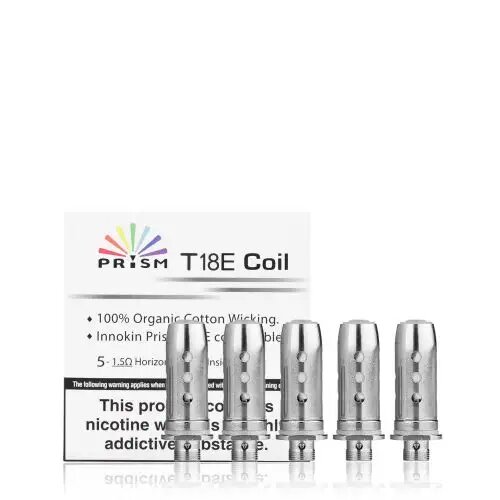
Round wire. The traditional coil is a wire spiral, sometimes two in parallel. Coils like the Innokin Prism T18e coils in the header photo are this classic wound design. The whole length of wire heats at once, but liquid only touches it where the wire meets the cotton, so the contact area is smaller than with mesh.
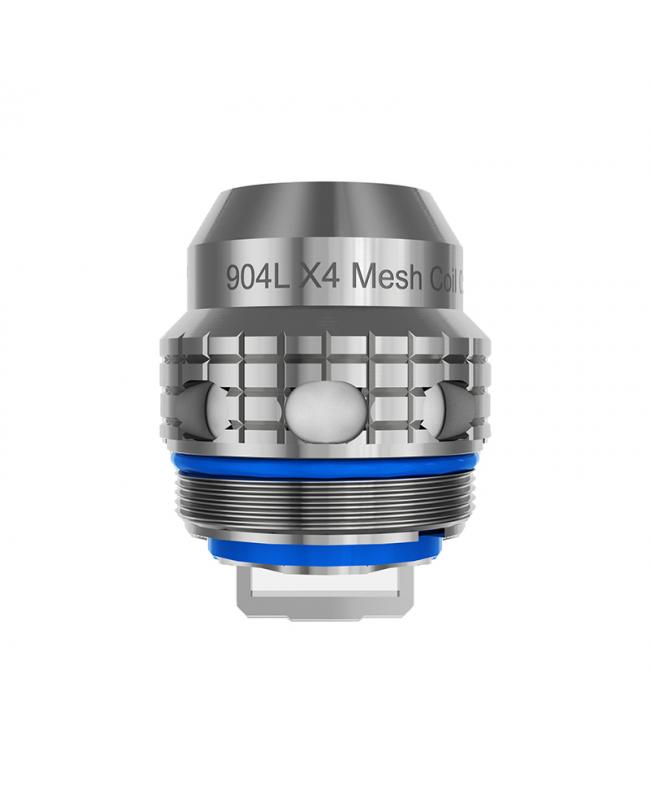
Mesh. A flat strip of metal punched with a fine grid. It touches far more of the cotton at once and heats more evenly, which tends to give fuller flavour and a quicker ramp-up. The Freemax 904L M and 904L X mesh coils are a good example of the design in a tank coil.
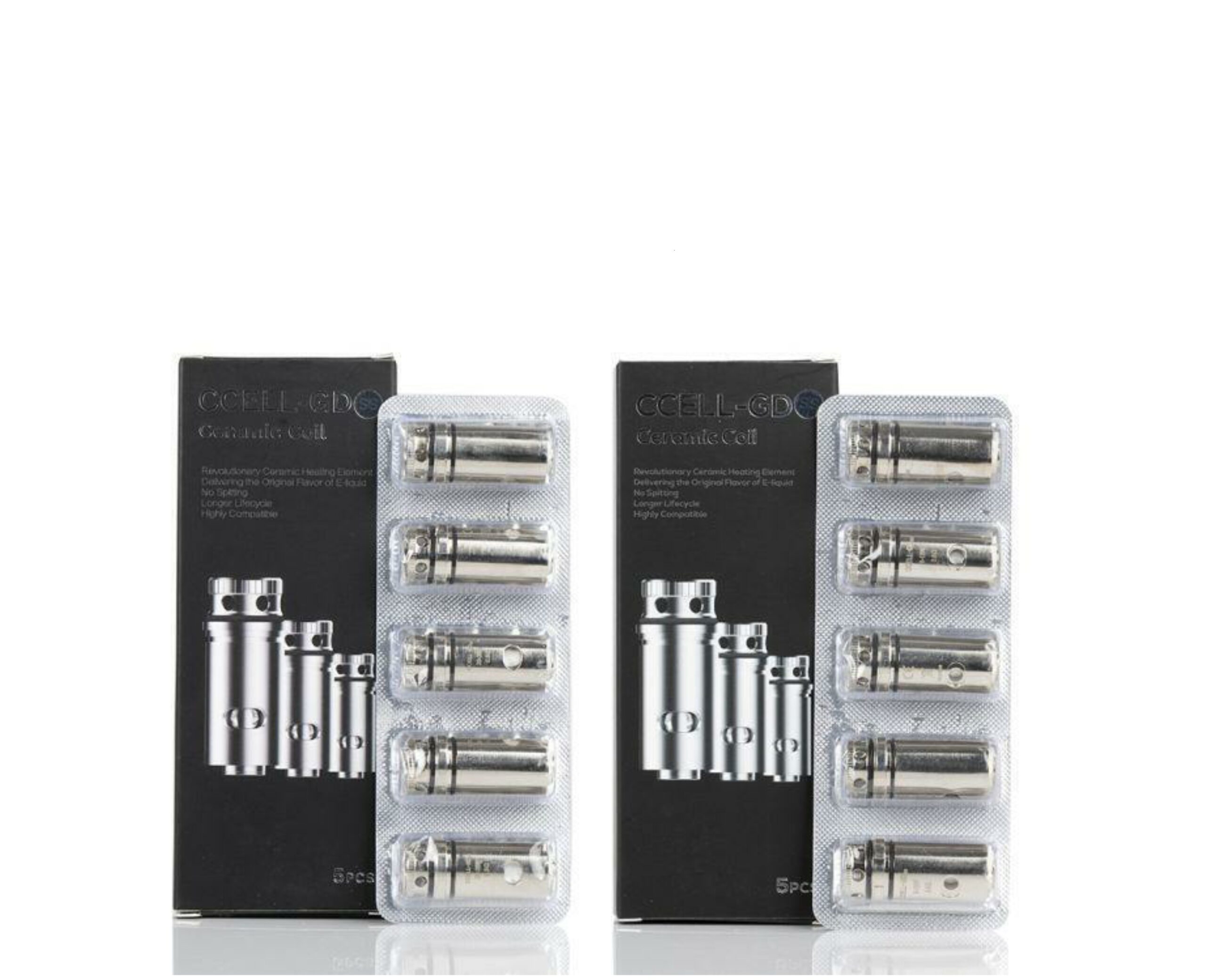
Ceramic. A porous ceramic body sits between the element and the liquid, so the heat reaches the liquid through the ceramic. The Vaporesso CCELL GD ceramic coils use this design, which trades some vapour volume for a gentle, clean taste.
If you’re weighing up mesh against a standard wire coil for your own kit, the side-by-side comparison is in what’s the difference between mesh and regular coils.
The cotton can only work as fast as liquid can flow into it. Thin liquids flow quickly; thick liquids flow slowly. E-liquid is mostly propylene glycol (PG), which is thin, and vegetable glycerine (VG), which is thick, so the ratio on the bottle tells you how quickly it will wick.
Coil designers size the wicking ports to match. A tight MTL pod coil has small ports and runs at low power, so it wants a thinner liquid that flows in easily without flooding. A low-resistance coil vaporises liquid much faster, so it has large ports and needs a thicker liquid that won’t pour straight through. As a rule, 50/50 suits MTL coils of 0.6 ohm and above (typically 0.6 to 1.2 ohm); high-VG 70/30 suits coils below about 0.6 ohm.
In practice that means 10ml e-liquids and nic salts in pod kits, and 70/30 shortfills in sub-ohm tanks. The full picture is in our guide to PG/VG ratios.
A coil never works alone. The air you pull through the device does two jobs: it carries vapour to the mouthpiece and it cools the element, so the cotton isn’t cooked between puffs.
A tight airflow gives a warmer, denser draw that feels close to a cigarette draw. That’s the mouth-to-lung style most pod kits are built around. A wide-open airflow gives a cooler, looser draw that you take straight into the lungs, which is how low-resistance coils are meant to be used. Mismatch them, with wide-open air on a tight MTL coil or a pinched airflow on a sub-ohm coil, and the coil runs too cold or too hot. Our guides to MTL vs DTL vaping and adjustable vs fixed airflow help you set it up.
Every heat cycle leaves a trace of residue on the element and slowly breaks down the cotton, so no coil lasts forever. A pod or tank coil is typically changed every one to three weeks. If yours are dying much faster than that, our guide to why coils burn out fast covers the causes, and how to know when your pod or coil needs changing lists the signs that a coil is finished.
The good news is that understanding how the coil works makes looking after it easy: keep the wick wet, stay inside the wattage range, match the liquid to the coil and let the airflow do its job. Our full range of replacement coils is listed by brand and kit.
Free UK delivery over £15, 1.8 reward points on every £1 and 20,000+ five-star reviews. New here? Register at checkout for 10% off your first order.
It’s the coil’s electrical resistance. Higher numbers suit low-power mouth-to-lung vaping. Anything below 1.0 ohm is technically sub-ohm, and coils below about 0.6 ohm need more power for a bigger, looser draw.
No. Each coil has a rated range. Going above it heats the element faster than the wick can refill, which burns the cotton and shortens the coil’s life.
Dry cotton scorches the moment the element heats it. A few drops on the cotton and five to ten minutes’ soak after filling means the first puff vaporises liquid, not cotton.
No. Coils are made for specific tanks and pods, and a coil from another range won’t fit or seal. Buy the coil named for your device.
The pod holds the liquid; the coil heats it. Some pods take a replaceable coil, others have the coil built in, so the whole pod is replaced when the coil wears out.