

Two separate ideas are bolted together in the name, and it is worth pulling them apart.
Shortfill describes the bottle. A 60ml bottle arrives holding 50ml of liquid, or a 120ml bottle holding 100ml. That empty space at the neck is not a packing error. It is there so you can pour in a nicotine shot and end up with a full bottle at a usable strength.
50/50 describes what is inside. Every e-liquid is mostly two carrier liquids: propylene glycol, which is thin, carries flavour and gives the throat hit, and vegetable glycerin, which is thick, sweet and makes vapour. Split them evenly and you get a balanced liquid that leans towards flavour rather than cloud.
Put those together and you have something most shortfill shelves do not offer: a large-format bottle that behaves like a 10ml. That is the whole point of the category. Browse the current range in shortfills, and if you want the full format comparison read shortfill vs 10ml e-liquid.
UK law limits any bottle containing nicotine to 10ml, and limits strength to 20mg/ml. There is no route around it. A 500ml bottle of 20mg salt is not a thing that can legally be sold here, and any listing that claims otherwise is either mislabelled or not a UK product.
What the law does not limit is nicotine-free liquid. So manufacturers mix the flavour base at 0mg, bottle it at 50ml, 100ml, 200ml or more, and sell a 10ml nicotine shot separately. You do the last step. It is a legal workaround that turned into the standard way heavy users buy liquid, because the cost per millilitre falls sharply as the bottle gets bigger.
This is also why the phrase “100ml nic salt” is nonsense. There is no such product in the UK, only a 100ml 0mg shortfill and the salt shots you add to it. If you want the detail on what you can and cannot buy, our guide to UK vape law covers it.
PG and VG are not flavours. They are the base the flavour rides on, and the split changes almost everything about how a liquid behaves in a device.
PG is watery. It soaks into cotton fast, which matters enormously in a pod where the wicking holes are small and the coil is only a millimetre or two away. It also carries flavour compounds better, so a 50/50 tastes more defined than the same recipe at 70/30. And it delivers the scratch at the back of the throat that ex-smokers tend to want.
VG is syrupy. It makes dense visible vapour, it sweetens and softens the liquid, and it is gentler on the throat. It is also slow to wick, which is fine in a sub-ohm tank with big juice channels and a problem in a 1.0Ω pod.
An even split is the compromise that suits the most devices. It is why most 10ml bottles are 50/50, and why a 50/50 shortfill is the large-bottle format that makes sense for a pod user. If you are still working out which camp you are in, read MTL vs DTL vaping.
| 50/50 | 70/30 VG | |
|---|---|---|
| Consistency | Thin, wicks in seconds | Thick, needs time to soak |
| Flavour | Sharper and more defined | Rounder and sweeter |
| Throat hit | Noticeable, close to a cigarette | Soft |
| Vapour | Modest and discreet | Dense |
| Coil range | 0.6Ω and above (typically 0.6 to 1.2Ω) | Below 0.6Ω |
| Right kit | Pod kits and MTL tanks | Sub-ohm tanks and mods |
This takes about ninety seconds and the bottle is designed to make it hard to get wrong.
| Shortfill | Shots added | Shot strength | Finished strength |
|---|---|---|---|
| 50ml | 1 | 18mg | 3mg in 60ml |
| 50ml | 1 | 20mg salt | About 3.3mg in 60ml |
| 100ml | 2 | 18mg | 3mg in 120ml |
| 50ml with 10ml decanted out | 2 | 18mg | 6mg in 60ml |
Finished strength = shot strength × shot volume ÷ total volume. To go above one shot per 50ml you have to decant 10ml of the base into a second bottle first, because the neck space only allows for one shot. The 40ml left plus two 18mg shots gives 6mg in 60ml.
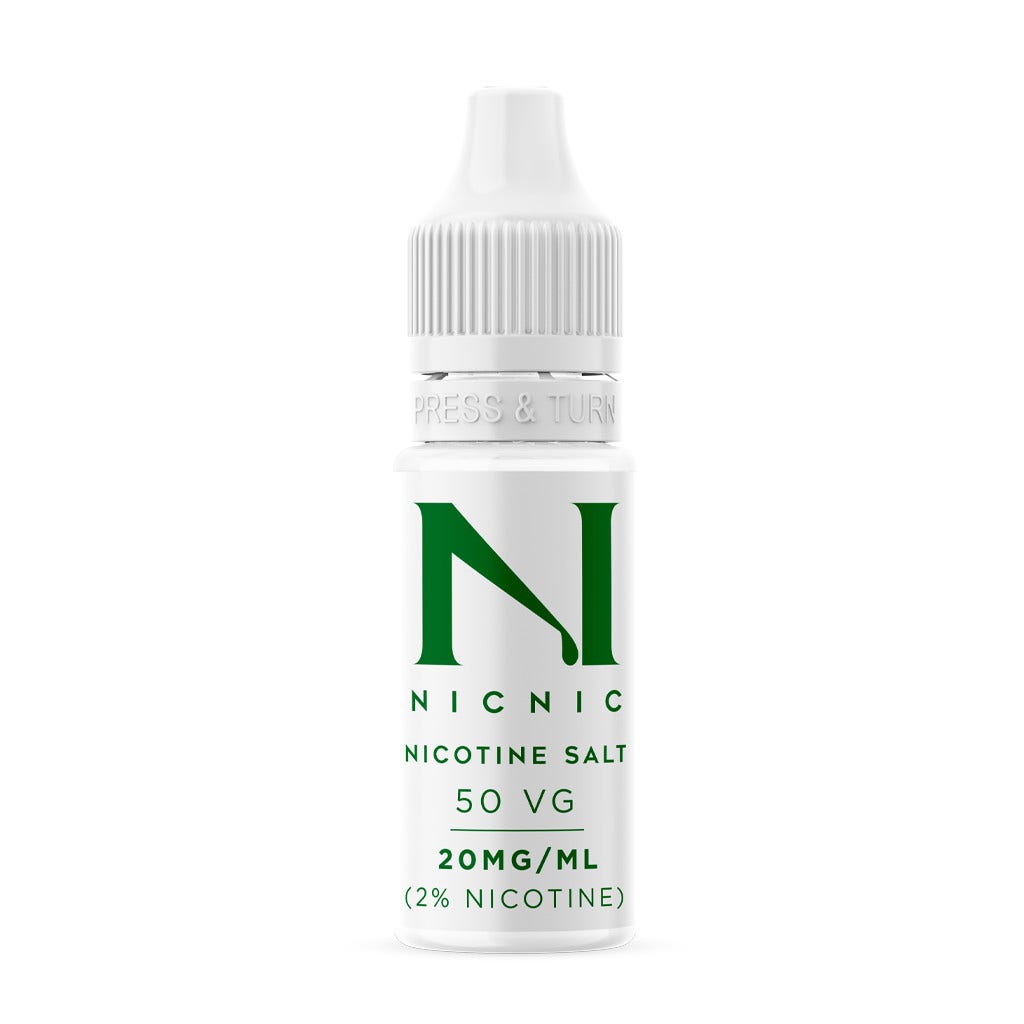
The ceiling is the catch. Mixed the standard way, a shortfill comes out at a low strength. That is a good number if you vape a mid-power device and do not need much nicotine, and too low for anyone who uses 10mg to 20mg in a small pod. No amount of arithmetic gets a shortfill there.
So the rule is simple. If your strength is 6mg or below, a 50/50 shortfill is the cheapest way to buy it. If you need 10mg or more, you want 10ml nic salts instead, and a multi-pack is where the value sits. Read how much nicotine should I vape if you are not sure which side of that line you fall on.
Plenty of people run both. A 50/50 shortfill in the tank at home and a couple of stronger 10ml bottles in a coat pocket is a sensible setup.
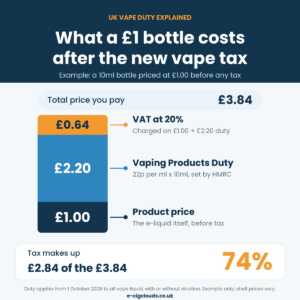
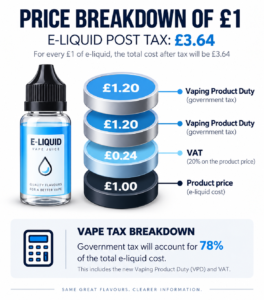
Vaping Products Duty starts on 1 October 2026 at £2.20 per 10ml plus VAT, which is £2.64 landing on the shelf price of every 10ml of liquid sold in the UK. It applies to nicotine-free liquid too, so a 0mg shortfill is taxed on its own volume and every nic shot you add is taxed as another 10ml.
In pounds, that hurts a big bottle more than a small one. A 100ml with two shots is 120ml of taxable liquid, so £31.68 of tax. But the duty is flat per millilitre, and it does not change the reason shortfills were cheaper in the first place: the base price per ml of a big bottle is a fraction of the base price per ml of a 10ml. The duty adds the same amount to every millilitre, so the difference in base price per ml between a big bottle and a 10ml is unchanged.
| What you buy | Taxable volume | Duty plus VAT |
|---|---|---|
| One 10ml bottle | 10ml | £2.64 |
| 50ml shortfill plus one shot | 60ml | £15.84 |
| 100ml shortfill plus two shots | 120ml | £31.68 |
Stock released before 1 October 2026 carries no duty and can be sold until 31 March 2027. Our guide to e-liquid shelf life and storage covers how to keep a big bottle in good condition.
Buying 100ml of something is a commitment. A flavour you enjoy in a 10ml can wear thin by the fourth tank, so the choices that hold up over a big bottle tend to be the simpler ones.
Fruit and menthol age well. Berry, apple, lemonade and anything with ice in it stay bright and rarely get sickly. A fruit liquid is the safest large-format purchase there is.
Dessert and custard are riskier. They are excellent in short bursts and heavy going as an all-day vape. They also gunk coils faster because of the sweeteners, which costs you more in replacement coils than you saved on the bottle.
Tobacco is a personal thing. Try it in a 10ml before you buy the big one. It is the flavour category people most often get wrong.
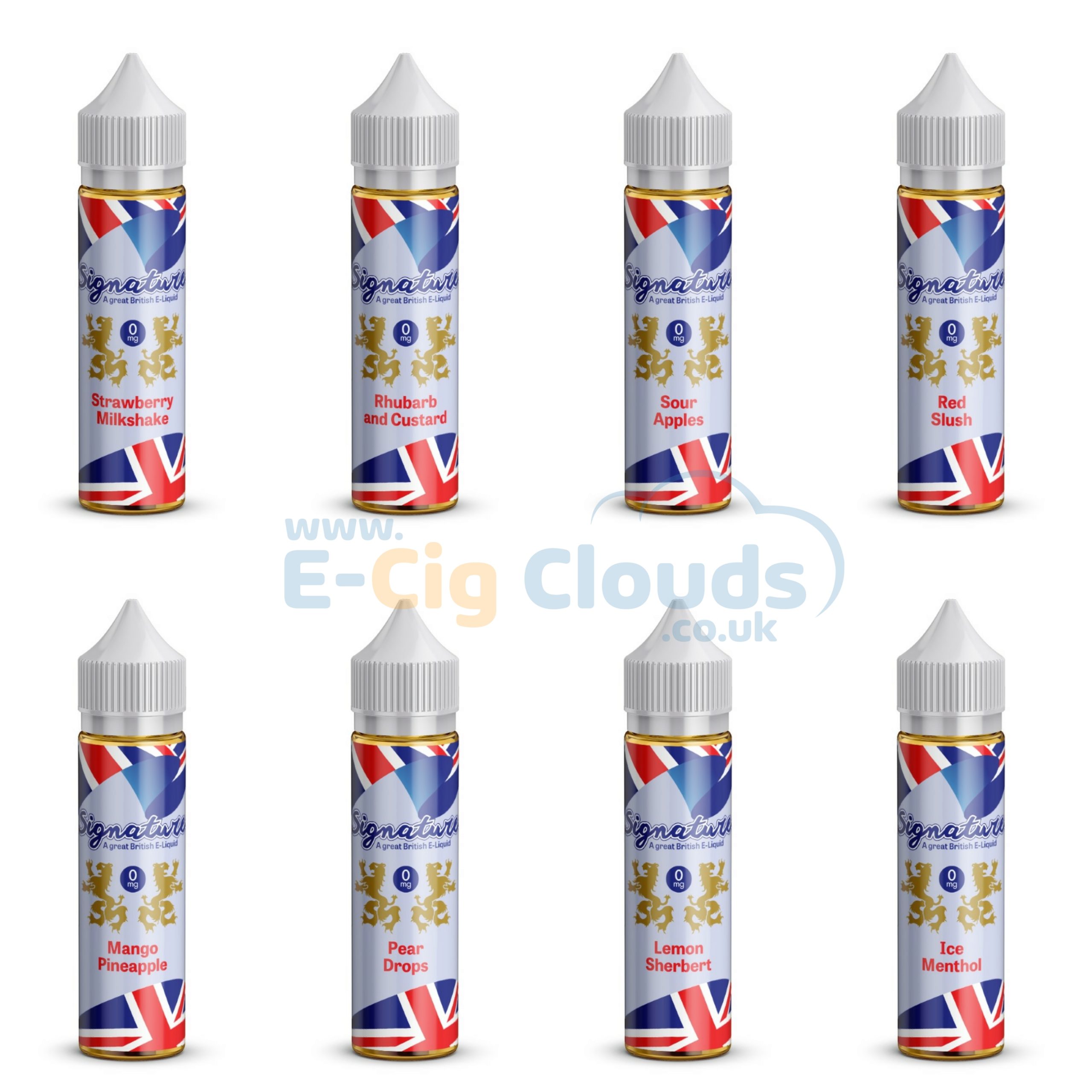
Test-drive in a 10ml, then size up. A Signature 50ml shortfill is a reasonable first step up, and if you are certain, Kingston bottles go up to 500ml.
One more thing worth saying plainly: keep nicotine shots capped, labelled and well out of reach of children and pets. They are small bottles at 18mg or 20mg and they do not look like anything dangerous.
Free UK delivery over £15, 1.8 reward points on every £1 and 20,000+ five-star reviews. New here? Register at checkout for 10% off your first order.
Yes. It ships at 0mg and is perfectly usable as it is. If you vape without nicotine, a 50/50 shortfill is simply a large 0mg bottle.
No. A shortfill is a nicotine-free base. A nic salt is a specific form of nicotine, sold ready-mixed in small bottles or as a shot. You can put a salt shot into a 50/50 shortfill, which gives you a salt-based liquid at the low strength shortfills are built for.
It will run, but it is thin for a low-resistance coil and you may get spitting and leaking. A 70/30 is the better match below 0.6Ω.
A hard shake and ten minutes is enough for a 50/50. Thin liquids blend quickly, unlike high-VG mixes that genuinely benefit from a few days.
The gap is deliberate. It is the room left for your nic shot, so a 60ml bottle arrives holding 50ml and fills up once the shot goes in. If you never add nicotine, you simply have a slightly underfilled bottle of 0mg liquid.