

Pouches are often confused with snus. Snus contains ground tobacco and its sale is banned in the UK and most of the EU. Nicotine pouches contain no tobacco, which is exactly why they fell outside tobacco legislation and, until recently, outside vape legislation too.
The route changes how the nicotine feels. The Royal College of Physicians’ 2016 report Nicotine without smoke describes inhaled nicotine as the fastest route to the brain and products absorbed through the mouth, such as gum, as slower and steadier. Vaping is an inhaled route, though delivery varies with device power, liquid type and how you puff. A pouch is an oral route: it sits in place and works for as long as it is in.
That has practical consequences. A vape lets you take one puff and put it down, so intake is easy to adjust moment to moment. A pouch is a fixed dose that you commit to for half an hour, and once it’s in you can’t take half of it out.
Strengths aren’t comparable across the two formats. E-liquid is labelled in milligrams per millilitre, and UK law caps it at 20mg/ml; how much you absorb depends on how much liquid you vaporise. Pouches are labelled in milligrams per pouch, commonly from around 3mg up to 20mg and, for some imported brands, considerably higher. Our guide to how nicotine strengths are labelled covers the vaping side; for pouches, labelled strengths vary from brand to brand.
This is the biggest difference between the two and the one most people don’t know about. Vaping products in the UK are governed by the Tobacco and Related Products Regulations 2016 (TRPR). Every nicotine e-liquid and device must be notified to the MHRA before sale, liquid is capped at 20mg/ml and 10ml per bottle, tanks and pods at 2ml, packaging must be child-resistant with health warnings, and advertising is heavily restricted. Sales to under-18s have been illegal since 2015. Our UK vape law guide goes through it all.
Nicotine pouches contain no tobacco and aren’t vaped, so the TRPR doesn’t apply to them. They’ve been sold under the General Product Safety Regulations, the same framework as most consumer goods. That means, at the time of writing, no statutory nicotine cap, no mandatory MHRA notification, no mandatory health warning format and no product-specific age-of-sale law (most retailers and trade bodies applied an 18+ rule voluntarily). We do not sell any vaping product, including 0mg, to anyone under 18, and the Tobacco and Vapes Act 2026 extends the legal age-of-sale rules to nicotine-free vapes.
The Tobacco and Vapes Act 2026, which received Royal Assent on 29 April 2026, changes that. It provides for age-of-sale rules covering nicotine pouches, and it gives ministers the power to make regulations setting a maximum nicotine content per pouch, restricting flavours, controlling packaging and point-of-sale display, and limiting advertising. The Act sets the powers; the actual numbers and dates will come through secondary regulations, so if you use pouches expect the products on the shelf to change over the next couple of years, in much the same way vaping products did when the TRPR came in.
| Vaping | Nicotine pouches | |
|---|---|---|
| Route | Inhaled aerosol | Absorbed through the gum |
| Speed of effect | Inhaled; the RCP report describes inhaled nicotine as faster-acting | Oral; the RCP report describes oral forms as slower and steadier |
| Strength labelling | mg per ml, max 20mg/ml by law | mg per pouch, set by each brand |
| UK regulation | TRPR 2016, MHRA notification, Tobacco and Vapes Act | General product safety law |
| Visible? | Yes, vapour and device | No |
| Hand-to-mouth ritual | Kept | Gone |
| Kit and upkeep | Charging, pods or coils, liquid | None, a tin in your pocket |
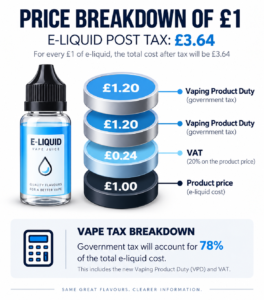
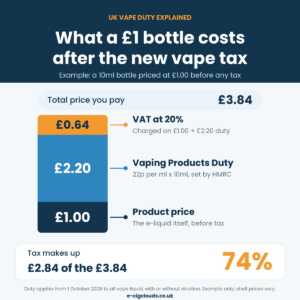
| Tax | Vaping Products Duty from 1 October 2026, plus VAT | VAT only at present |
| Reported by some users (not a clinical list) | Dry mouth, throat irritation, coughing early on | Gum soreness, hiccups, nausea from strong pouches |
The “reported by some users” row reflects what some users of each format report online and in reviews. It is not a clinical comparison and no medical conclusion should be drawn from it. The NHS states that vaping is not risk-free. If you experience persistent symptoms with either product, see your GP.
This is where pouches win on convenience and it’s the main reason people carry both. Vaping isn’t covered by the 2007 smoking ban, but almost every train operator, airline, airport, office, pub chain and stadium bans it under their own rules, and you can’t vape on a plane at all (see can you vape on a plane). A pouch has no vapour and no smell, so nobody knows you’re using it. A long-haul flight, a shift where you can’t leave the floor, a wedding, a hospital visit: these are the situations pouch users talk about.
The flip side is that invisibility makes it easy to lose track. With a vape, the act of stepping outside creates a natural gap between doses. With pouches there’s no gap unless you make one.
Three things. First, the format: a vape is a handheld device that is inhaled, so it involves a hand-to-mouth action and visible exhaled vapour. Second, flavour as an experience rather than a background note; a pouch is minty or fruity, a vape can taste of a dessert. Third, finer control over dose, because you decide how often and how deeply to puff, and with a refillable kit you choose the labelled strength of the liquid.
Vapes come in two broad formats. A prefilled pod kit is a rechargeable battery that takes ready-filled 2ml pods: you charge it, fit a pod and replace the pod when it runs out. A refillable pod kit is filled by the user from a bottle of up to 10ml, in any labelled strength from 20mg/ml down to 0mg. Our prefilled pod kit guide and pod filling guide describe how each works. Single-use disposable vapes have been banned in the UK since 1 June 2025.
No kit, no charging, no leaks, no liquid to store away from children, nothing to break. A tin fits in a coin pocket and lasts as long as the number of pouches in it. There’s no vapour, so no complaints from anyone nearby and no ban to fall foul of.
Against that: the dose is fixed once it’s in, strengths aren’t standardised or capped, and the regulatory framework is still catching up, which means the labelling and warnings you’d take for granted on a bottle of e-liquid may be inconsistent across pouch brands. We don’t sell pouches, and this article isn’t a recommendation to buy them. It’s a description of what they are.
Both formats deliver the same addictive substance. The NHS calls nicotine highly addictive; the Royal College of Physicians reports that it raises heart rate and blood pressure for a short period after each dose; and the NHS advises pregnant women to speak to their midwife or GP, and says that vaping is not for under-18s or for people who don’t already use nicotine. None of that changes with the format. We’ve set out the evidence, source by source, in is nicotine dangerous.
The practical difference is labelling. E-liquid strengths are standardised in mg/ml and capped by law. Pouch strengths are whatever a brand chooses to sell, so the “low” option from one brand may be stronger than the “regular” from another. If the goal is to reduce or stop nicotine entirely, that’s a conversation for your GP, a pharmacist or your local NHS stop smoking service. Our vaping and medication guide explains why that conversation matters if you take regular medicines.
These guides are information for adults who already vape. Our delivery and returns and rewards pages cover how the shop works.
Yes. They contain no tobacco so they aren’t caught by the snus ban. They’ve been sold under general product safety law rather than the vaping rules.
No. One is milligrams per pouch, the other is milligrams per millilitre of liquid, and the two routes absorb differently. Don’t assume the numbers match, and ask a pharmacist if you’re unsure what a strength means for you.
Some people do, a vape at home and pouches where they can’t vape. Keep track of how much nicotine you are using across both, and if you’re on any medication, ask your pharmacist first.
No. E-Cig Clouds sells vaping products only. This article describes both formats so that adults who already use nicotine understand how they differ; it is not a recommendation for either.
No. Vaping Products Duty applies to vaping liquid only, from 1 October 2026. Pouches carry VAT but no product duty at present, though that could change with future legislation.