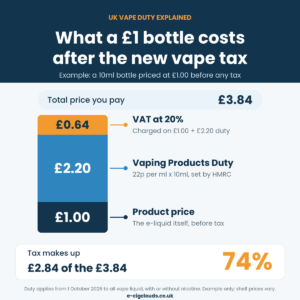


Vaping Products Duty is charged at £2.20 per 10ml of vaping liquid, with or without nicotine, and VAT is added on top, which brings it to £2.64 per 10ml. HMRC says the duty is paid by manufacturers, importers and approved warehousekeepers.
That timing is what creates pre-duty stock. Liquid that was produced in, or imported into, the UK before 1 October 2026 is not liable to the duty, so no duty was paid on it and it carries no duty stamp. Liquid produced in or imported into the UK from 1 October 2026 onwards is liable to the duty and must carry a vaping duty stamp.
Rather than force shops to throw away or re-label stock overnight, HMRC set a grace period. Its guidance for wholesalers and retailers, last updated on 7 October 2026, says businesses can keep selling eligible unstamped stock produced or imported before 1 October 2026 until 31 March 2027, as long as they can show when the stock was produced or imported.
For the full maths on what the duty adds to each format, read our vape tax explainer.
The duty and the stamp scheme come in over several steps. These are the dates in HMRC’s guidance and its press release of 1 October 2026.
| Date | What happens | What it means on the shelf |
|---|---|---|
| 1 October 2026 | Duty starts; liquid released onto the UK market must carry a duty stamp | New stock arrives stamped; older stock is still unstamped |
| 31 December 2026 | Last day transitional stamps without digital features can be affixed | Some early stamps have no scannable code |
| 1 January 2027 | Digital stamps mandatory for new products made in or imported into the UK | New stamps include a scannable code |
| 31 March 2027 | End of the grace period for eligible unstamped stock | Last day unstamped stock can be sold |
| 1 April 2027 | All vaping products outside duty suspension must carry a stamp | Only stamped liquid products can be sold; hardware is unaffected |
No. A pre-duty bottle and a duty-paid bottle of the same product contain the same liquid. The difference is when the liquid was produced in or imported into the UK, and therefore whether duty was paid and a stamp fitted. Strength limits, bottle sizes and labelling rules are the same for both: nicotine liquid still comes in bottles of up to 10ml at a maximum of 20mg/ml, and pods and tanks are still limited to 2ml.
During the grace period you may see two versions of the same product in UK shops: an older unstamped box and a newer stamped one. Neither is better or worse to vape. HMRC’s press release says passing the duty on to consumers is a commercial decision for each business, so how quickly shelf prices change varies from shop to shop.
Liquid has a shelf life whichever side of the date it was made. Buy the sizes you will finish, and store bottles somewhere cool and dark. Our e-liquid shelf life guide explains how long sealed and opened bottles keep, and our guide to how long 100ml lasts helps you match bottle size to how much you vape.
The stamp is the quickest way to tell the two apart. Based on HMRC’s guidance, this is what to check on a box.
A box with no stamp is not automatically illegal before the deadline, because it may be eligible pre-duty stock. That changes on 1 April 2027. For a closer look at the stamps and a per-millilitre duty chart for every bottle size, see our vape duty by bottle size guide.
HMRC’s guidance is clear about the deadline. Any unstamped stock must have been sold, returned to the supplier, exported, destroyed or otherwise lawfully dealt with before 1 April 2027. From that date, all vaping products outside duty suspension in the UK must have a vaping duty stamp attached.
HMRC also tells retailers to check where stock came from, whether the supplier can provide normal invoices and delivery notes, and, for unstamped products, whether they were produced or imported before 1 October 2026. Its advice is that a business that cannot satisfy itself stock is legitimate should not buy, supply or sell it.
The stamp scheme sits alongside the wider UK rules on what can be sold. Our UK vape law guide covers strength caps, bottle sizes and the Tobacco and Vapes Act.
The duty is charged on vaping liquid only, so the stamp and the grace period are about liquid products. Hardware with no liquid in it carries no vaping duty at all, before or after the deadline.

Because the duty is the same per millilitre on every format, it does not change which format is cheapest per ml. Our shortfill vs 10ml guide compares the two main ways of buying liquid.
The duty also changed the rules for travellers from 1 October 2026. HMRC’s press release says that people arriving in Great Britain can bring up to 50ml of vaping liquid for personal use without paying duty and tax. Larger amounts must be declared, and duty is then paid on the full quantity, not just the amount over 50ml.
Northern Ireland has separate rules: arrivals from outside the EU can count vaping products towards their personal allowance for other goods, and arrivals from the EU must bring products for personal use only. If you are flying, our guide to vaping on a plane covers batteries, liquids and cabin rules.
Free UK delivery over £15, 1.8 reward points on every £1 and 20,000+ five-star reviews.
Until the grace period ends, yes, if the stock was produced or imported before 1 October 2026 and the seller can show it. From 1 April 2027 HMRC says unstamped vaping products must not be sold.
Not necessarily before the deadline. Genuine stock produced or imported before the duty started has no stamp. After 31 March 2027, an unstamped product on sale in a UK shop is a warning sign.
No. The duty applies to vaping liquid, so hardware with no liquid in it, such as refillable kits, coils, batteries and empty pods, does not need a duty stamp. Prefilled pods and prefilled pod kits contain liquid, so they are covered.
No. The stamp shows duty has been paid. The liquid, its strength and its ingredients are the same as an unstamped bottle of the same product.
HMRC says it must be sold, returned to the supplier, exported, destroyed or otherwise lawfully dealt with before 1 April 2027. Holding or selling it after that may lead to penalties.